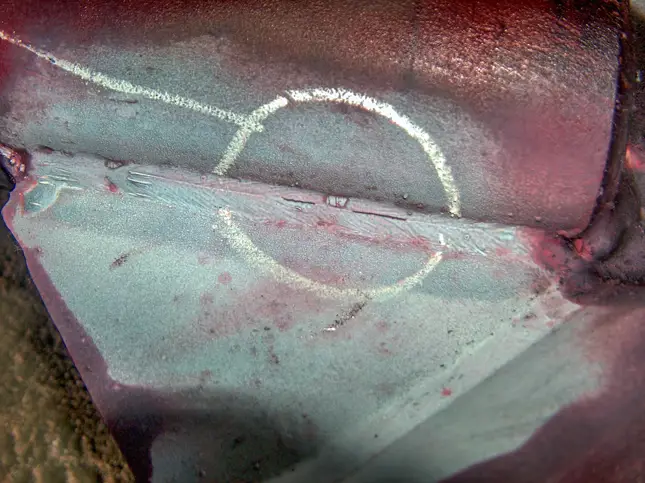
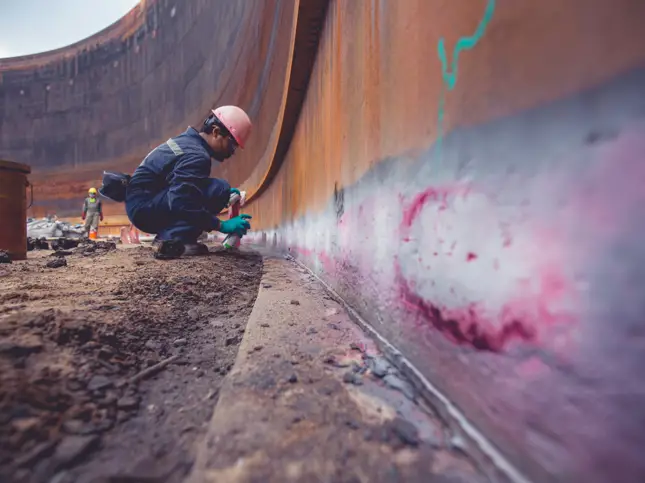
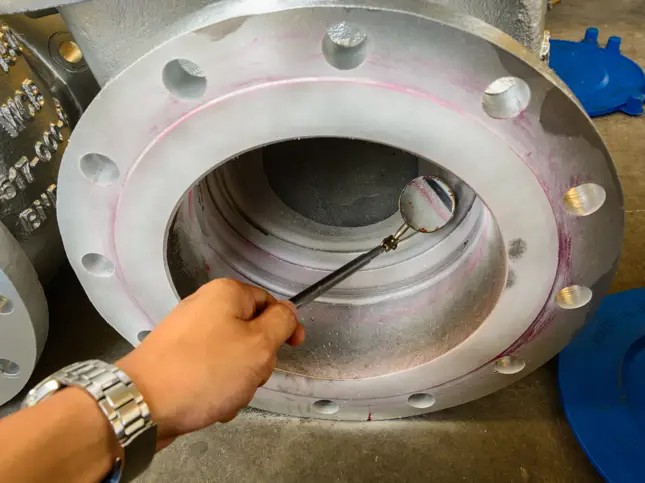
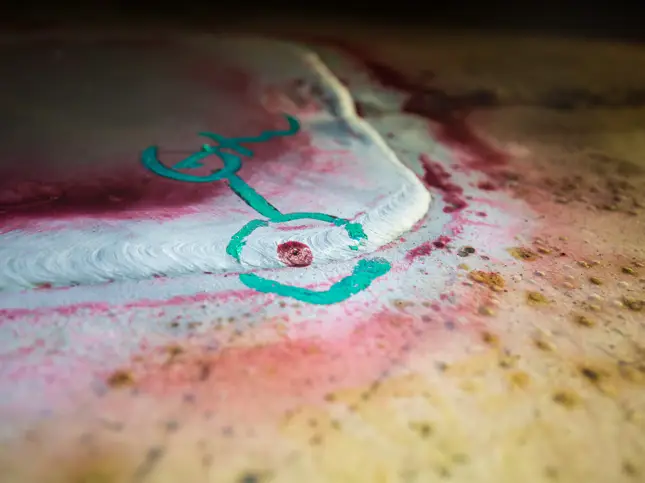
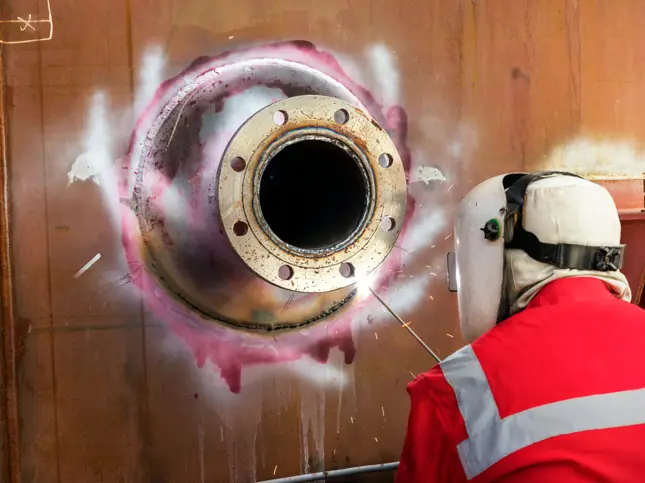
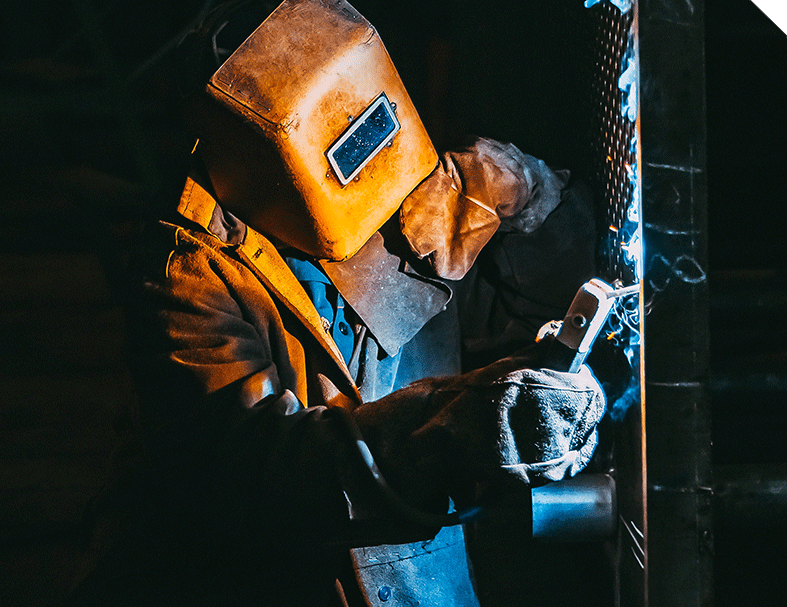
Our Dye Penetrant Testing (PT) services are designed to detect fine surface defects that may not be visible during standard visual inspections. This method is highly effective for identifying cracks, porosity, and other surface discontinuities that could affect the integrity of components.
At Arab Wondars, Dye Penetrant Testing (PT) is used as an effective non-destructive testing method to detect surface-breaking defects in non-porous materials. This technique is widely applied to identify cracks, porosity, laps, and other discontinuities in welds, castings, and metal components.
How Liquid Penetrant Testing Works
Liquid penetrant testing involves applying a visible or fluorescent dye to a clean and dry surface. The penetrant seeps into any surface defects through capillary action, making otherwise invisible flaws detectable.
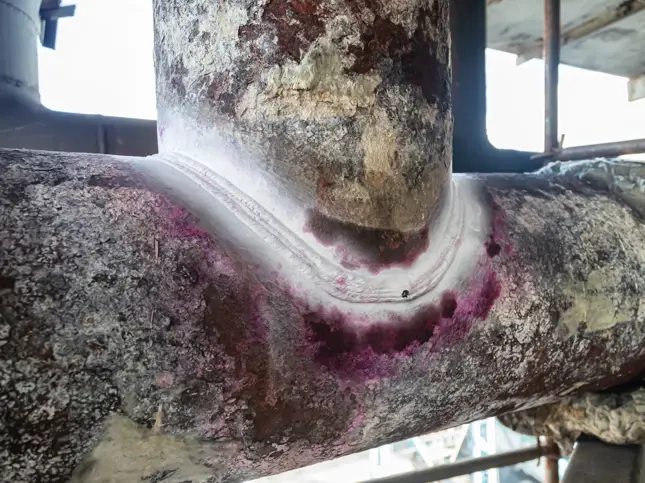
After allowing sufficient dwell time, excess penetrant is carefully removed, and a developer is applied. The developer draws out the trapped penetrant from defects, creating clear and visible indications that can be easily inspected and evaluated.
Principles of Dye Penetration Test Methods
Principle of Dye Penetrant Testing
Dye Penetrant Testing (PT) operates on the principle of capillary action, where a liquid penetrant is drawn into surface-breaking defects such as cracks or discontinuities. These flaws are then made visible using contrast techniques under normal lighting or ultraviolet (UV) light, allowing inspectors to easily identify and evaluate defects.
Penetrant Materials Used in Testing
At Arab Wondars, we utilize a range of high-quality penetrant materials to ensure accurate and reliable inspection results, including:
Visible red dye penetrants for inspections carried out under normal lighting conditions
Fluorescent penetrant systems for enhanced sensitivity when inspected under UV light
Specialized solvents and emulsifiers suited for different cleaning and removal processes
Visible Dye vs. Fluorescent Dye Penetrant Inspection
At Arab Wondars, our certified technicians use both visible dye and fluorescent dye penetrant inspection techniques based on the specific inspection environment and sensitivity requirements.
Visible dye penetrants are suitable for inspections under normal lighting conditions and are widely used for routine evaluations.
Fluorescent dye penetrants provide enhanced visibility under ultraviolet (UV) light, making them ideal for detecting fine defects in low-light or enclosed environments.
Penetrant Removal Techniques
To ensure accurate inspection results, Arab Wondars applies different penetrant removal methods depending on project requirements:
Water-washable method – Commonly used in controlled environments for efficient and easy cleaning
Solvent-removable method – Ideal for on-site inspections where portability and flexibility are required
Post-emulsifiable method – Offers higher sensitivity and better control for detecting very fine defects
At Arab Wondars, we utilize advanced dye penetrant testing (PT) techniques to identify surface defects such as cracks and porosity that could compromise the structural integrity of critical assets. This method plays a key role in ensuring the safety and reliability of structures including bridges, buildings, and offshore platforms.
PT Inspection for Fabricated Components and Weld Seams
Our penetrant testing services are widely applied to inspect fabricated components and welded joints, helping detect issues such as fatigue cracks, lack of fusion, and other surface-breaking defects. These inspections are essential for maintaining quality in both newly manufactured components and existing structures in operation.
The dye penetration test method highlights cracks and porosity that are not visible on standard visual inspection. This method improves reliability and confidence in welds and castings.
Cost-Effective, Quick, and Non-Destructive
Our penetration testing offers quick turnaround and low setup requirements the simplicity of the test method makes it an affordable and efficient option in many routine inspection procedures.
High Sensitivity for Non-Porous Materials
Dye penetration testing is ideal for smooth, non-porous metals and ceramics, as even fine cracks can be detected with high accuracy using liquid penetrant testing. This helps prevent failures that could lead to severe safety or operational, or compliance issues.
Why Choose Our PT Inspection Services?
Certified NDT Level II & Level III Technicians
At Arab Wondars, all dye penetrant testing (PT) activities are performed by qualified Level II and Level III NDT technicians. Our team is trained and certified in accordance with internationally recognized standards, ensuring accurate inspections and dependable results across a wide range of applications.
Compliance with International Codes and Standards
Our penetrant testing procedures strictly follow key industry standards such as ASME Section V, ASTM E165, and ISO 3452. We provide detailed and traceable documentation for every inspection, supporting full compliance with regulatory and client-specific requirements.
On-Site and In-House Testing Capabilities
Arab Wondars offers flexible inspection solutions with both on-site (mobile) and in-house testing capabilities. Our technicians use portable inspection kits for field applications, while controlled in-house facilities are utilized for projects requiring a more structured testing environment.
Why Choose Arabwondars for Radiographic Testing Services?
Certified RT Technicians and Advanced Equipment
At Arab Wondars, our radiographic testing (RT) services are performed by certified technicians trained in accordance with internationally recognized standards such as ISO 9712 and ASNT. We utilize advanced X-ray and gamma radiography systems to deliver precise and reliable inspection results across both on-site and in-house environments.
Digital Image Processing and Efficient Reporting
We provide modern digital radiography solutions that enable fast image processing, secure data storage, and easy accessibility. Inspection results can be quickly reviewed, shared, and archived with full traceability, supporting informed decision-making, reducing downtime, and maintaining comprehensive asset records. Our streamlined workflow ensures efficiency for both high-volume inspections and detailed defect analysis.
Compliance with Industry and Regulatory Standards
All radiographic testing procedures at Arab Wondars are conducted in line with globally recognized standards such as ASME, ASTM, API, and ISO. Our strong QA/QC systems ensure compliance with the strict requirements of regulated industries, including oil and gas, marine, power generation, and industrial sectors, delivering reliable and audit-ready inspection services.
Penetration testing is a non-destructive testing method (NDT) used to reveal surface cracks and defects in non-porous materials by applying a visible or fluorescent dye.
The primary goal of penetration testing is to detect and reveal open surface defects, including cracks, porosity or laps that could lead to structural issues or quality failures in critical components.
Liquid penetrant testing is a low-cost, easy to apply testing method that is sensitive to fine surface cracks, particularly on smooth and non-porous metals. However, it only detects surface-breaking defects and cannot be used on porous surfaces.